Kurt Vonnegut wrote about me!

“I not only pronounce those about to graduate as women and men. With all the powers vested in me, I pronounce them Clarks as well. Most of you know, I’m sure, that all white people named Clark are descended from inhabitants of the British Isles who were remarkable for being able to read and write.

A black person named Clark, of course, would be descended, most likely, from someone who was forced to work without pay or rights of any kind by a white person named Clark.

An interesting family—the Clarks. I realize that you graduates are all specialized in some way. But you have spent most of the past sixteen or more years learning to read and write.

People who can do those things well, as you can, are miracles and, in my opinion, entitle us to suspect that we may be civilized after all. It is terribly hard to learn to read and write. It takes simply forever. When we scold our schoolteachers about the low reading scores of their students, we pretend that it is the easiest thing in the world: to teach a person to read and write. Try it sometime, and you will discover that it is nearly impossible.

What good is being a Clark, now that we have computers and movies and television?

Clarking, a wholly human enterprise, is sacred. Machinery is not. Clarking is the most profound and effective form of meditation practiced on this planet, and far surpasses any dream experienced by a Hindu on a mountaintop. Why? Because Clarks, by reading well, can think the thoughts of the wisest and most interesting human minds throughout all history. When Clarks meditate, even if they themselves have only mediocre intellects, they do it with the thoughts of angels.

What could be more sacred than that?”

Kurt Vonnegut, If This Isn’t Nice, What Is?: The Graduation Speeches and Other Words to Live By.

_______________________________________________

I am a Clark. It is very exciting to read a famous author praising my family name. Especially as he includes a caveat for those those of us with ‘mediocre intellects.’

But more importantly Kurt is praising reading and writing.

And we Clarks don’t have a monopoly on that. In fact this Clark wants to join Kurt in encouraging everyone to do more Clarking.
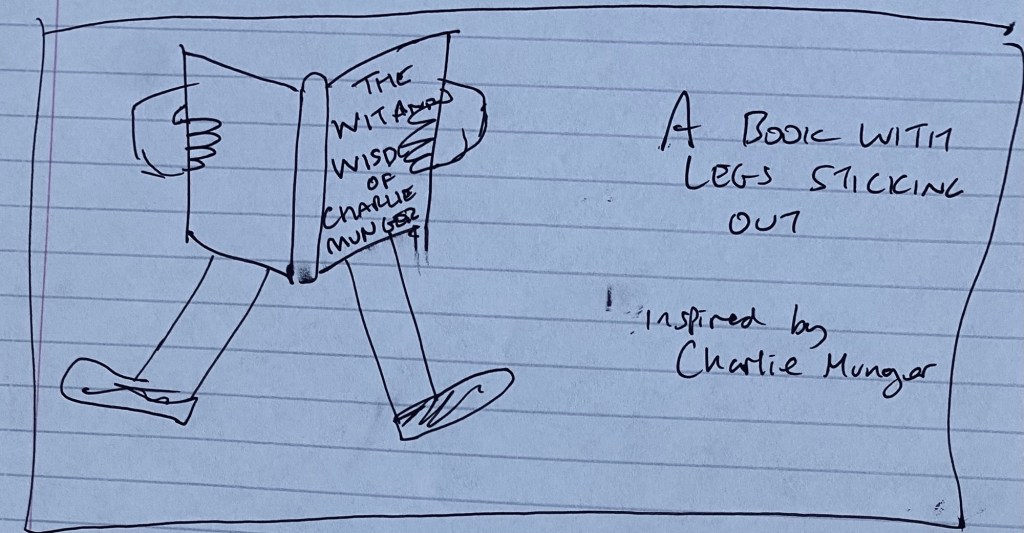
“A book with legs sticking out”

“The learning and teaching opportunities related to investing are essentially unlimited. Munger likes to say that a successful investor never stops being a “learning machine.” This need to learn and relearn means that an investor must read and think constantly. Munger has said he does not know a single successful investor who does not read voraciously. His own children describe him as a “book with legs sticking out.””

Tren Griffin, Charlie Munger: The Complete Investor

_______________________________________________

I’d be happy to called a book with legs sticking out. A type of android. A learning machine.

Although my reading doesn’t have the purposefulness of Mr Munger, I can still justify it as my biggest positive addiction:

________________________________________________

“Usual Frame: Avoid addiction. Reframe: Choose your addictions wisely.

This reframe acknowledges the reality that humans are by nature easily addicted, but we are not addicted to the same things in the same ways…

Look for ways to consciously add positive addictions to your life to crowd out your less-helpful impulses…

I fill my schedule with positive addictions to leave less room for the toxic type. I sometimes call this reframe the Pleasure Unit Theory. The idea is that humans need a minimum daily amount of pleasure or else life will not be worth living.”

Scott Adams, Reframe Your Brain

______________________________________________

I enjoy thinking of reading as a positive addiction. Is it wrong to be addicted to learning?

Writing is a recent addition to my list of positive addictions.

This blog is evidence of that.

The magician doesn’t reveal the awkwardness of magic

I know I am not a magician, that magic is just illusion. The illusion of spontaneity. It looks effortless, effortless to the audience. But there’s countless hours of practice done in private.

The magician has sweated over his act for hours and all the audience sees is the execution, the finished project, the magic

The magician does not want you to see all of their awkward stumbles and mistakes during practice. Neither do we. We want to be amazed, fooled. That’s why we watch magic.

Good ideas through writing do not just flow or arrive like magic. They are revealed to the author through practice.

We write down everything that comes to mind, gather them together, then start to shape them. Our audience doesn’t see the cutting and pasting, erasing and spell checking. But that is all necessary to create our act.

We hope that by the time we have shared the idea with our audience there will be a little bit of magic created, the magic of connection and inspiration.

What do I know about how I like to know more?

Of everything I need to know, the most important is how I like to do things and what makes me feel good.

It will be different to any other person.

But it is so important to figure out what you like to do and the way that you like to do it. Learn what keeps you going, motivated, and what makes you feel good doing it.

It is a good plan to focus and create systems to allow ourselves to do more of what makes us feel alive.

For me it has become blogging. I feel an immense energy and sense of satisfaction from having posted here.

My system: write down thoughts as they come wherever and whenever.

Strip all formality out of learning and recording thoughts.

No laptop and keyboard. All done on my iPhone or paper and pen.

Start a new draft post and put in an idea or a title or a quote.

Return when I think of a way to making it publishable.

Multiple ideas started and saved.

No curriculum. Learn about whatever I want.

No use of the word should whilst thinking of what I want to learn or write about.

Only what I want to learn.

Trusting in my intuition to lead me.

Collecting nuggets with Eric Hoffer

“Originality is not something continuous but something intermittent—a flash of the briefest duration. One must have the time and be watchful (be attuned) to catch the flash and fix it. One must know how to preserve these scant flakes of gold sluiced out of the sand and rocks of everyday life. Originality does not come nugget-size.”

Eric Hoffer, quoted in Tom Bethell, Eric Hoffer The Longshoreman Philosopher, loc 3602

_________________________________________________

I love Eric Hoffer! If I was a fan of emojis I would have lots of animated hearts around his name.

I think his message here is: don’t worry about having big ideas and carving out large amounts of time to write. Just keep your eye out for the glittering flakes in the stream of your day. Collect them by writing down what comes to you, before it gets washed away in the current.

Once written down you don’t need to think or try to remember these ideas. They are collected forever and you can go about your day.

One day you will put your hand in your pocket to find your accumulated flakes (in my case loads of notes on my iPhone), and see those fragments have accumulated to the weight of a blog post, a song, an article, a talk, a podcast,a book.

Or perhaps they are perfect as they are and it is nice to be reminded that you noticed and took note.

Eric Hoffer being watchful for those flakes of originality
(picture: https://www.hoover.org/research/longshoreman-philosopher)

Off the record

The juiciest information is shared off the record.

Our best thoughts often occur off the record when we are not thinking and writing but doing other things.

This is not part of the official, formal work. But if we win the trust of our subconscious by spending quality time writing, then it will start divulging the good stuff.

And because it’s our sub conscious talking off the record, then we have permission to publish its ideas.

It can start sharing at any time, so keep your notebook handy…

Jim Harrison on wishing to be

“I can’t quarrel with the limitations which are part of me—everybody has the severest of limitations. You are ultimately what you collectively wish to be. When someone says they could be so much more, I say well, you better get started right now, who’s stopping you? Face it, there’s an anchor tied to your ass.”

Jim Harrison, in Robert DeMott, Conversations With Jim Harrison, p.131

__________________________________________

My favourite writer. And this book of interviews with him is absolutely jam packed with wisdom. It’s hard to describe when a writer affects you deeply. It’s more felt than thought. And feelings are harder to explain than thoughts. I feel Jim Harrison’s writing. The miracle of books: he died in 2016 yet his energy is still being piped to the living, providing me with inspiration fuel.

David Leddick on preserving self esteem

“I never want anyone to feel worse about themselves after I leave than they did before I arrived… it is my number one rule in life. I never want to damage anyone’s self-esteem. I may not be here to make you feel much better about yourself but I am certain that I am not here to make you feel worse. Even if you would really like me to.”
David Leddick, I’m Not for Everyone. Neither Are You.

__________________________________________

That’s exactly how I feel about my approach to teaching. Self-esteem is fragile. It’s so easy to wreck. What a great rule!

Slightly too much coffee, not quite enough time.

Sometimes when I’m lucky and I have the right balance of slightly too much coffee and not quite enough time and freedom my brain is wonderfully creative. Lurching and straining forward like horses under reins held by Charlton Heston, pulling his chariot. My brain feels like it is straining from its tether. It wants to know more. It wants to do more. I’m in Flow. I feel Pleasure.