The Foolscap method for everything

“I was having a cheeseburger with my friend and mentor, the writer and documentarian Norm Stahl. I was trying to start my first novel at the time, and I was dazed, confused, baffled, stumped, lost, perplexed, and desperate. Norm happened to have a pad of yellow legal-sized foolscap paper in his briefcase. He took it out and set it on the table between us. “Steve,” Norm said, “God made a single sheet of yellow foolscap to be exactly the right length to hold the outline of an entire novel.” At one stroke, Norm knocked 99.99% of the preciousness out of me. He gave me a key to transforming myself from an amateur to a pro.”

Steven Pressfield, The Daily Pressfield, location 994

__________________________________________

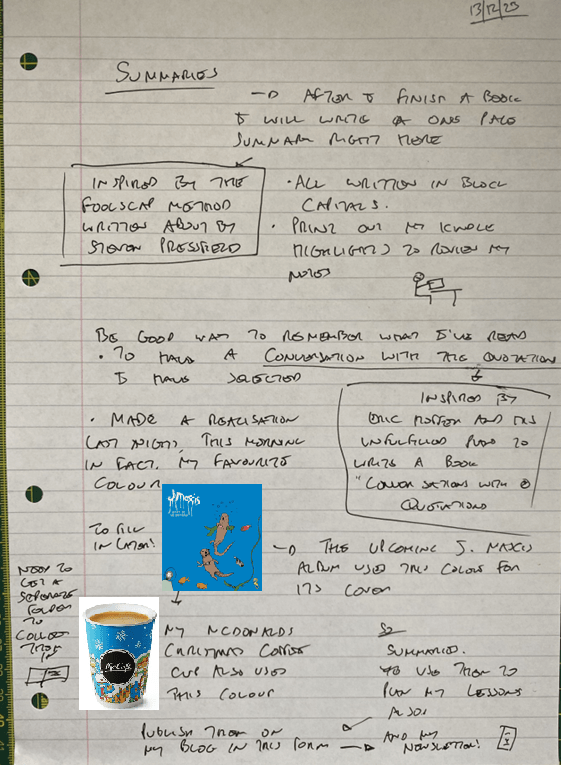
I have started to use this for everything: lesson plans, book summaries, writing summaries. Its a wonderful example of a the theory of constraints. The limitation creates the method. If you can’t summarise your idea, project or lesson in one page of A4 then perhaps you don’t know what you’re talking about or want to write about.

This method is about simplification. It reminds me of Richard Feynmann’s technique for learning: can you explain it to a child? Children don’t like dense text and big words. They are captivated by good stories and respect those who respect their limited attention span.
One page of A4 is enough to summarise anything

________________________________________

I have just read the following sentence by Scott Adams. I love it when my quotations start having conversations with each other:

“Write at a Sixth-Grade Level For most kinds of writing—from humor to business—the best sentence is the simplest one that gets the message across. If you use words that a twelve-year-old would understand, you will sound like the smartest person in the conversation. As a bonus, your ideas will stand out more since they’re not buried in word debris. Simple sentences are better in every way. They are more persuasive, easier to remember, and easier for others to consume. Don’t fall into the trap of mistaking long sentences and brainy jargon for genius-level insight”

Scott Adams, Reframe Your Brain, p.73
Hey, this is just a hobby!

A way of taking the pressure off of starting something that you secretly hope will be successful is to frame it for yourself and others as being merely a hobby.  

You can share your work and be happy if people stumble upon it. Any feedback or criticism you can deflect with, “hey, it’s just a hobby!”

This permits you to be openly enthusiastic and niaeve because there are no expectations. 

People expect eccentricities and over excitement with hobbies because they have no consequence. Hobbies are not taking away from paying the mortgage. There are no deadlines. There is no pressure to perform. It’s done because it brings joy.

Just like this blog. I love writing and am a bit doolally over reading and books. I do it all for the joy of it.

Just don’t take me too seriously.

Because hey, this is just a hobby!

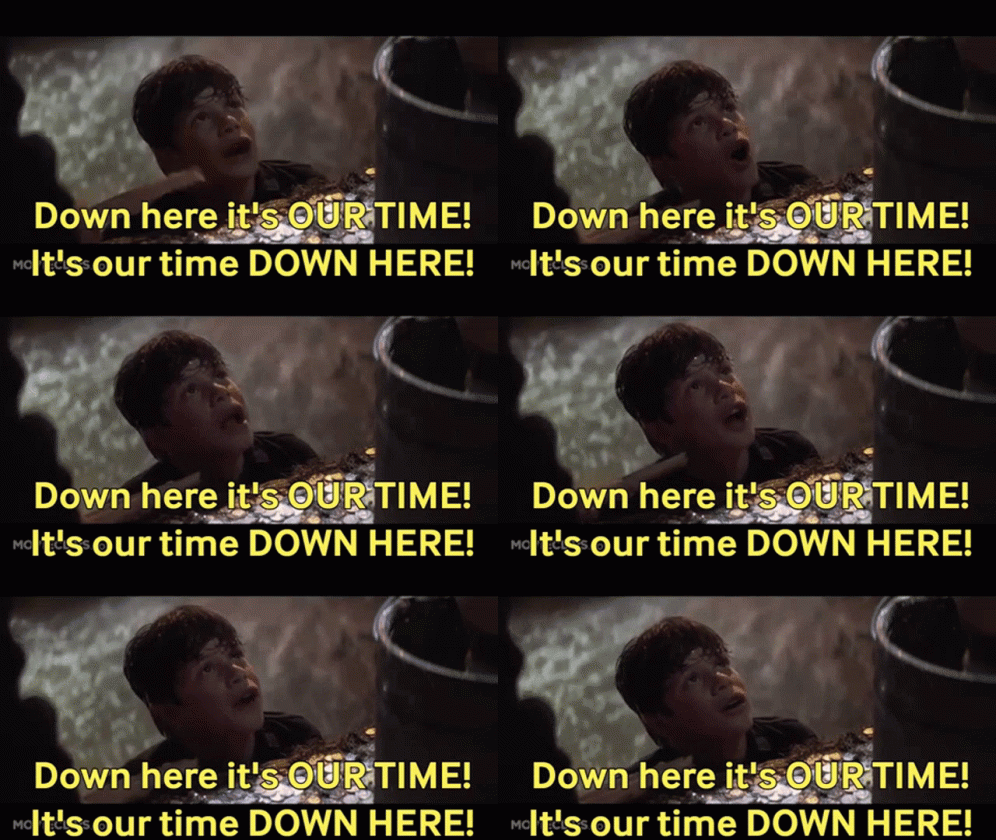
Its our time down here

“But right now, they got to do what’s right for them.

Because it’s their time.

Their time! Up there!

Down here, it’s our time.

It’s our time down here.”

Mikey, The Goonies

___________________________________________________

Mikey says they should stay down in the underground caves, following the trail for One -Eyed Willy’s treasure.
This is about them following their destiny as young people rather than worrying about returning to the surface: to the adult world; to their parent’s expectations and priorities.

This scene keeps coming back to me. I just love it. I think it’s so powerful to think about our own practice, separate from the rest of the world. It’s what we do that makes us feel like we’re on our own adventure, seeking our own rewards below the surface of wider responsibilities.

Like my writing. When I write my morning pages. Early morning. At the table. With my coffee. That’s my time, before the demands of the day, of my job, of others. I do something for myself, and I’m not worrying about what the outside world expects or demands from me.

I’d like to stay down here and continue my own quest for lost treasure,
but I have to resurface. I will descend again tomorrow…

Our most valuable posessions

“A lot of people I’ve talked to seemed surprised that I’ve kept all these notes.

I don’t understand why they think that.

I don’t understand why I’ve kept anything else.

What could possibly be of more value?

– Jerry Seinfeld, Is This Anything? p.9

___________________________________________________

“The act of writing, though often tedious, can still provide extraordinary pleasure. For me that comes line by line at the tip of a pen, which is what I like to write with, and the page on which the lines are written, the pages, can be the most valuable thing I will ever own.

– James Salter, Don’t Save Anything: Uncollected Essay, Articles and Profiles, Page 14

Big Yellow Legal pad

How many references to yellow legal pads are there in books about creative work?

They are often cited as a key tool for creation, for writing.

For example, Jerry Seinfeld talks about it briefly in his book, Is This Anything?

The Legal pad is the unsung link in the creative act.

It is not fancy.

It is low technology. But it is still technology nonetheless.

Cheap and widely available.

How many truly successful creative people write/talk about finding the perfect notebook? Who actually says they cannot work without the right notebook or pen? Very few. All you need is a biro and a legal pad. Jerry Seinfeld even talked about running down biros til they are empty. This guy is worth hundreds of millions yet he doesn’t feel the need to adapt his creative process. It worked. It works and there is an extremely high chance that it will continue to work in the future.

In the UK we don’t use yellow legal pads. Ours are plain white. But that doesn’t matter. You can write on them just the same. Creativity is colour blind.

The power of Drew Robinson

On Sunday evening I started reading an article on ESPN.com just before bed (https://www.espn.co.uk/mlb/story/_/id/30800732/san-francisco-giants-outfielder-drew-robinson-remarkable-second-act). I had to stay glued to my phone and finish the story despite the head nodding. The article tells the story of Drew Robinson a professional baseball player with the San Francisco Giants. But the story is not really about baseball. Its about how Drew Robinson shot himself in the head, survived for 20 hours(!) before calling for help, and how he has made a remarkable recovery. It is about a young man who is being completely honest about his suicide attempt, what led him there, and how he is now out to regain the life he almost lost.

There is a quote from the piece that really resonated with me:

“He wanted to see himslef the way he believed everyone else saw themselves.”

Jeff Passan, San Francisco Giants outfielder Drew Robinson’s remarkable second act, https://www.espn.co.uk/mlb/story/_/id/30800732/san-francisco-giants-outfielder-drew-robinson-remarkable-second-act

It is very easy to make assumptions about other people. To assume they see themselves as confident and on top of everything. I have definitely been frustrated with my own self-image. I have negatively compared myself to others (and still do). It is very humbling to hear of a young man who took those thoughts to the ultimate level of self destruction. But he survived!

I salute Drew Robinson: for his honesty; bravery; and making the most of a miracle.

Wondering and not knowing

The one who wonders not only does not know, he is intimately sure that he does not know, and he understands himself as being in a position of not‑knowing. But this un‑knowing is not the kind that brings resignation. The one who wonders is one who sets out on a journey, and this journey goes along with the wonder: not only that he stops short for a moment, and is silent, but also that he persists in searching. – Josef Pieper1

1 As quoted in The Pathless Path, Paul Millerd.